Herbs for lymphatic support appear in teas, capsules, tinctures, and multi-herb formulas. This guide compares seven commonly mentioned plants by botanical identity, plant part, key compounds, traditional context, evidence quality, and safety. HerbEra takes a cautious view of this category: historical use can explain why an herb appears in a formula, but it does not confirm a measurable effect on human lymph flow.
No herb on this list has conclusive clinical evidence showing that it increases lymphatic drainage in healthy people. Most available research examines chemical composition, laboratory activity, traditional use, or unrelated health outcomes. Persistent swelling, heaviness, skin changes, or reduced movement needs professional evaluation rather than a supplement-only approach.
What does lymphatic support mean?
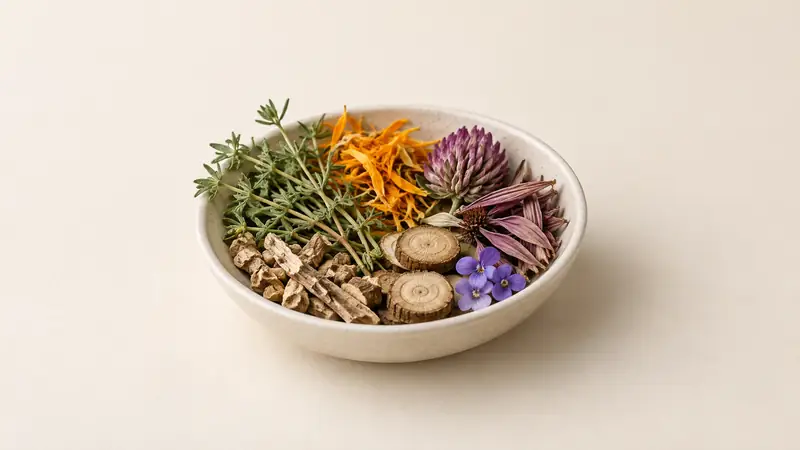
Lymphatic support is a broad wellness phrase without a standardized clinical definition. Product labels may use it to describe herbs traditionally associated with fluid balance, skin health, immune function, or normal elimination. These are different outcomes and should not be treated as proof of faster lymph movement.
The lymphatic system helps maintain fluid balance and carries immune cells through a network of vessels and nodes. It has no central pump like the heart. Muscle contractions, breathing, body movement, and pressure changes help lymph travel through vessels with one-way valves.
Regular movement has a clearer practical connection to lymph movement than any herbal ingredient. Herbs may still have a place in a personal wellness routine, but expectations should match the available evidence.
Which herbs are traditionally used for lymphatic support?
Cleavers is the herb most directly associated with traditional lymphatic formulas. Calendula, red clover, echinacea, dandelion, burdock, and violet also appear in Western herbal preparations. Their traditional roles overlap, but their compounds, product forms, and safety considerations differ.
| Herb | Botanical name | Common plant part | Notable compounds | Evidence for lymph flow |
|---|---|---|---|---|
| Cleavers | Galium aparine | Aerial parts | Iridoids, flavonoids, phenolic acids | No reliable human trials measuring lymph flow |
| Calendula | Calendula officinalis | Flowers | Triterpenoids, flavonoids, carotenoids | No direct clinical evidence |
| Red clover | Trifolium pratense | Flowering tops | Isoflavones, flavonoids | No direct clinical evidence |
| Echinacea | Echinacea purpurea and related species | Root or aerial parts | Alkamides, polysaccharides, caffeic acid derivatives | No direct clinical evidence |
| Dandelion | Taraxacum officinale | Leaf or root | Phenolic acids, flavonoids, sesquiterpene lactones | No direct clinical evidence |
| Burdock | Arctium lappa | Root | Inulin, lignans, phenolic acids | No direct clinical evidence |
| Violet | Viola odorata | Leaves and flowers | Mucilage, flavonoids, saponins | No direct clinical evidence |
How do the seven herbs differ?
1. Cleavers
Cleavers, also called goosegrass or stickyweed, is an annual plant in the Rubiaceae family. Herbal products usually use its aerial parts. The plant contains iridoids, flavonoids, and phenolic acids, but the exact profile varies with growing conditions, harvest timing, and extraction method.
Traditional Western herbal practice associates cleavers with fluid balance and lymphatic-focused formulas. Modern studies have mainly examined its composition and laboratory activity. They have not established that oral cleavers products increase lymph flow in humans.
A shopper comparing tea, tincture, and Galium aparine capsules should confirm that the label identifies the botanical species and aerial plant parts. The amount per serving, extraction details, added ingredients, and testing information also matter. A convenient dosage form does not establish a stronger effect.
2. Calendula
Calendula products use the flowers of Calendula officinalis. These flowers contain triterpenoids, flavonoids, and carotenoids. Calendula has a long history in preparations associated with the skin, mouth, throat, and tissue comfort.
Its presence in lymphatic formulas comes from traditional herbal practice rather than human research measuring lymph circulation. Oral capsules, teas, tinctures, oils, and topical products are not interchangeable. A topical preparation should not be swallowed unless the label specifically identifies it as an oral product.
Calendula belongs to the Asteraceae family. People sensitive to ragweed, daisies, chrysanthemums, or related plants may have a greater chance of an allergic reaction.
3. Red clover
Red clover uses the flowering tops of Trifolium pratense. It contains isoflavones, including formononetin and biochanin A. These compounds have structures similar to estrogen, which makes red clover different from the other herbs on this list.
Traditional formulas sometimes position red clover as an herb for skin and tissue wellness. Research in people has focused mainly on menopausal symptoms, cholesterol, and bone markers. Results have been inconsistent, and those studies do not demonstrate an effect on lymphatic drainage.
Red clover may be unsuitable during pregnancy or breastfeeding. People with hormone-sensitive conditions or those using anticoagulants, hormone products, or other medication should seek individualized guidance.
4. Echinacea
Echinacea is not one uniform ingredient. Products may contain Echinacea purpurea, Echinacea angustifolia, or Echinacea pallida. They may also use roots, aerial parts, expressed juice, or extracts. Each choice changes the chemical profile.
Echinacea appears in lymphatic-focused formulas because of its traditional association with immune and tissue responses. Human research has concentrated largely on respiratory use, not lymph movement. Evidence from one purpose cannot confirm performance for another.
Short-term use can cause digestive discomfort. Allergic reactions are possible and may be serious. Caution is appropriate for people with Asteraceae allergies, immune-related conditions, or medications that influence immune activity.
5. Dandelion
Dandelion leaf and dandelion root come from the same species, Taraxacum officinale, but labels should identify which part is present. The leaf is traditionally associated with urine production, while the root appears more often in digestive formulas.
Dandelion contains phenolic acids, flavonoids, and bitter sesquiterpene lactones. An increase in urination does not show that a product has changed lymphatic circulation. Urinary output, venous circulation, and lymph movement are separate processes.
Dandelion belongs to the Asteraceae family. People with gallbladder, bile duct, kidney, or medication-related concerns should discuss concentrated products with a healthcare professional.
6. Burdock
Burdock products most often use the root of Arctium lappa. The root contains inulin, phenolic acids, and lignans such as arctiin. Traditional Western formulas often combine it with herbs associated with skin or digestive wellness.
Laboratory and animal research has examined several burdock compounds, but this work does not confirm improved lymphatic drainage in people. Human safety data for concentrated, long-term use remain limited.
Burdock belongs to the Asteraceae family and may cause allergic reactions. Correct plant identification is important because historical cases of adulteration have involved other roots. Pregnancy and breastfeeding require extra caution because adequate safety information is lacking.
7. Violet
Sweet violet, Viola odorata, has a history of use in European and Persian herbal traditions. Products may contain leaves, flowers, syrup, tea, oil, or extracts. The leaves and flowers contain mucilage, flavonoids, saponins, and other plant compounds.
Violet sometimes appears in traditional formulas for skin, respiratory, or tissue comfort. Its connection with lymphatic support is historical. Clinical research has not established that violet increases lymph flow.
Product identity needs attention because several Viola species enter commerce. Oral safety information is limited, especially for concentrated extracts, children, pregnancy, breastfeeding, and extended use.
What does the scientific evidence show?
The evidence for these herbs falls into three main categories: traditional records, phytochemical analysis, and laboratory research. These sources can identify historical use and biologically active compounds. They cannot show that a finished supplement produces a meaningful change in human lymphatic circulation.
A clinical claim would require controlled human studies using defined products and relevant outcomes. Useful outcomes might include objectively measured tissue fluid, limb volume, lymphatic imaging, or validated symptom scores. Studies should also report dose, duration, plant part, extraction solvent, and adverse events.
Those data are not currently available for most products marketed with lymphatic language. HerbEra applies a label-first editorial standard here: the species, plant part, preparation, and serving size should be clear before anyone considers the product’s intended role.
Laboratory findings about antioxidant or immune activity do not establish better lymph drainage. The same applies to urine production. These are separate biological observations.
How should you compare herbal product formats?
Tea, powder, capsules, tinctures, and dry extracts deliver herbs in different ways. Milligram amounts cannot be compared without knowing the preparation.
- Tea: Uses water to extract soluble compounds from dried plant material.
- Whole-herb powder: Contains ground plant material and usually requires a larger weight than a concentrated extract.
- Capsule: May contain whole-herb powder, dry extract, or both. The label should make this distinction clear.
- Tincture: Uses alcohol, glycerin, or another liquid medium. The herb-to-liquid ratio helps describe concentration.
- Dry extract: Concentrates selected soluble compounds and may include a carrier to improve stability or flow.
A smaller number of milligrams does not automatically make an extract weaker, stronger, or more suitable. Look for the extract ratio, extraction solvent, dried herb equivalent, and standardized markers when provided.
Checklist for Evaluating a Lymphatic Support Herb
Use this checklist before buying a single-herb product or a blend. A complete label makes comparison easier and reduces uncertainty about what you are taking.
Confirm the botanical name
Look for the genus and species. A common name alone may refer to more than one plant.
Check the plant part
Root, leaf, flower, and aerial parts can contain different compounds and may have different traditional uses.
Identify the preparation
Determine whether the product contains whole-herb powder, a liquid extract, or a dry extract.
Read the serving amount
Check the amount per capsule or dropper and the total amount in the suggested daily serving.
Review every added ingredient
Look for carriers, capsule materials, sweeteners, preservatives, and other active herbs.
Look for quality testing
Useful testing can address botanical identity, microbial contamination, heavy metals, and undeclared substances.
Check the warnings
Consider allergies, medication use, pregnancy, breastfeeding, age, and existing health conditions.
Set a realistic expectation
Traditional use and laboratory findings do not confirm a measurable change in lymphatic circulation.
When should you seek medical advice?
Herbs are not an appropriate first response to unexplained or persistent swelling. Contact a healthcare professional if swelling affects one side, becomes progressively worse, limits movement, or appears after surgery, radiation, infection, or injury.
Sudden swelling with pain, redness, warmth, chest discomfort, difficulty breathing, faintness, or coughing blood needs urgent medical attention. Fever, chills, or rapidly spreading redness can also signal a time-sensitive problem.
If you already have lymphedema or use compression garments, ask your care team before adding massage techniques or concentrated herbal products. Individual factors can change what is appropriate.
FAQ
What is the most common herb for lymphatic support?
Cleavers is one of the herbs most closely associated with traditional lymphatic formulas. Human evidence showing increased lymph flow remains limited.
Can herbs increase lymphatic drainage?
No herb has conclusive clinical evidence showing that it increases lymphatic drainage in healthy people.
Are diuretic herbs the same as lymphatic herbs?
No. Diuretic activity increases urine production, while lymphatic circulation moves fluid through lymph vessels. One effect does not confirm the other.
Are capsules stronger than herbal tea?
Not automatically. Strength depends on the plant amount, plant part, extraction method, extract ratio, and serving size.
Can I combine several lymphatic herbs?
Combining herbs increases the number of possible allergies, side effects, and interactions. Review each ingredient separately before using a blend.
How long should I use a lymphatic support herb?
There is no universal duration. Follow the product directions and seek professional guidance for extended use or persistent symptoms.
Are these herbs suitable during pregnancy?
Safety information is incomplete for several of these herbs. Pregnancy and breastfeeding require guidance from a qualified healthcare professional.
What supports lymph movement without supplements?
Regular movement, muscle activity, breathing, and clinician-directed care have clearer links to normal fluid movement than herbal products.
Glossary
Aerial parts
The portions of a plant that grow above ground, such as stems, leaves, and flowers.
Botanical name
The standardized Latin genus and species used to identify a plant accurately.
Dry extract
A concentrated preparation made by extracting plant material and removing the liquid solvent.
Extract ratio
A statement comparing the starting weight of herb with the resulting amount of extract.
Flavonoid
A broad group of plant compounds found in many herbs, fruits, and vegetables.
Isoflavone
A plant compound with structural similarities to estrogen, commonly found in red clover and soy.
Lymph
A clear fluid that moves through lymphatic vessels and carries immune cells.
Standardized extract
An extract adjusted or tested to contain a stated amount of a selected chemical marker.
Conclusion
Cleavers, calendula, red clover, echinacea, dandelion, burdock, and violet are herbs traditionally associated with lymphatic support, but none has conclusive evidence of increasing human lymph flow. Compare products by species, plant part, preparation, dose, testing, and safety rather than relying on broad wellness language.
Sources Used
Cleavers phytochemical profile and laboratory research — pubmed.ncbi.nlm.nih.gov, Immunomodulatory Activity and Phytochemical Profile of Infusions from Cleavers Herb
Cleavers chemistry and extraction research — pubmed.ncbi.nlm.nih.gov, Phytochemical Profiles of Galium aparine
Echinacea evidence and safety overview — nccih.nih.gov, Echinacea
Red clover evidence and safety overview — nccih.nih.gov, Red Clover
Dandelion root scientific assessment — ema.europa.eu, Taraxacum officinale Root
Calendula flower scientific assessment — ema.europa.eu, Calendula Flower
Burdock root scientific assessment — ema.europa.eu, Arctium lappa Root
Violet traditional use and phytochemistry review — pubmed.ncbi.nlm.nih.gov, Critical Review of Viola odorata
Dietary supplement evidence and consumer safety — nccih.nih.gov, Using Dietary Supplements Wisely
Lymphatic movement and daily care principles — nhs.uk, Lymphoedema